






Realistic anatomical models for more efficient medical care
In a few years, will every doctor have his own 3D printer? Perhaps that is a step too far for now. But there is no doubt that 3D printing will gain a prominent place in hospitals. That market will increase more than fivefold in the coming years. Stratasys already offers complete solutions for smaller and medium-sized hospitals.
In 2020, healthcare organizations worldwide spent more than $1 billion on 3D printing. That will increase fivefold in the coming years. Researchers from Allied Market Research predict in their most recent analysis that approximately $5.8 billion will be spent on 3D printing for medical applications by 2030. Other market research firms predict even faster growth.
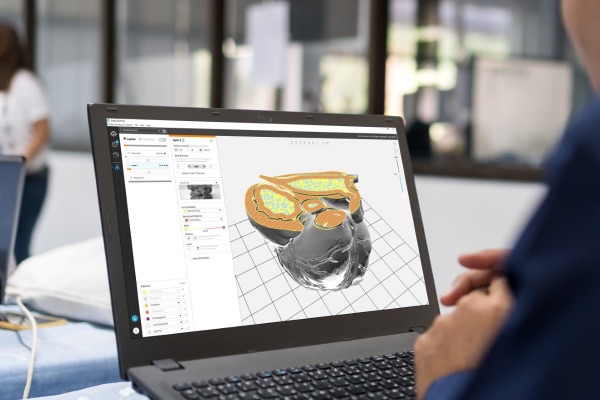
With Stratasys' Digital Anatomy Creator you can easily create anatomical patient models based on available patient-specific images.
Anatomical models
While until now it has mainly been complex orthopedic implants that have been printed, or models for complex operations, surgeons will increasingly want full-color models to better prepare for a growing number of operations. Healthcare providers are under pressure to provide more personalized care and ensure better surgical outcomes, while reducing costs. The latter can be done by shortening the effective time in the operating room. By 3D printing anatomical models, physicians can develop hyper-personalized treatment plans and prepare surgical procedures much better, because they have a model that exactly matches what they will find on the patient in the operating room.
Shorter operating time thanks to true-to-life anatomical models
Personalized care
Stratasys offers both software solutions and 3D printers for hospitals and other healthcare professionals who need anatomical models. With the new software module Digital Anatomy Creatorn, the healthcare provider quickly and easily creates a digital anatomical model. The ultra-realistic models accurately represent the patient's anatomy. “The Digital Anatomy Creator is the missing link between the patient, the printer and the final printed 3D anatomical model,” said Seth Friedman, PhD, Manager of Innovation, Imaging and Simulation Modeling at Seattle Children's Hospital. This allows the hospital to provide personalized care for each patient, which is especially important for children.

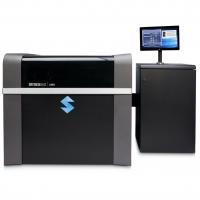
Thanks to the GrabCAD software for the Stratasys J5 MediJet, the different models and templates can be optimally nested for efficient use of the 3D printer.
Compact 3D printer for medical applications
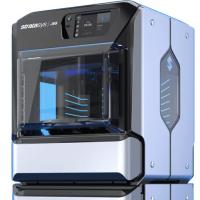
However, the Digital Anatomy Creator is only one half of the solution that Stratasys has developed for hospitals. The new Stratasys J5 MediJet full color 3D printer connects seamlessly to the software. With this 3D printer you can 3D print realistic anatomical models as well as medical drilling templates. Even though the J5 MediJet is a very compact 3D printer, its productivity and ease of use are at a high level. This is partly due to the patented turntable on which the products are printed and the fixed position of the print head. But also through the software to optimally nest the parts. This allows you to use the 3D printer very efficiently. And because the J5 MediJet can print multiple materials in one build job, the 3D printer is suitable for smaller hospitals. Multiple anatomical models can easily be combined with multiple molds in one build job, which is ready the next morning.
Medically certified materials
The Stratasys J5 MediJet printer supports multiple materials , including some biocompatible materials that are medically certified for temporary contact with tissue and bone. “For small to medium-sized hospitals, we make models and medical molds accessible with a medical 3D printer that is office-friendly and affordable, while sterilization is easy so that models can be taken directly to the operating room,” said Stratasys' Healthcare Vice President Osnat Philipp.

The compact dimensions and the ability to combine multiple materials in one build job also make the J5 MediJet suitable for smaller hospitals.
FDA certified workflow
By partnering with Synopsis and Materialize, Stratasys can provide an FDA 510(k) certified workflow. In that case, in addition to the Digital Anatomy Creator, the Synopsis Simpleware ScanIP Medical software as well as Mimics inPrint from the Belgian Materialize are also used. The Stratasys J5 MediJet printer is ISO 13485 certified for medical applications.
Are you curious about how 3D printing can take healthcare to a higher level of personalization and shorten operating times? contact then one of our specialists.

Over 20 years of experience
Experience, expertise, and customer satisfaction are the cornerstones of our company.

Authorized distributor
Your AM partner in the Benelux, France, and the Nordics, with service operations and local offices in each region.

Go for the best deal
We offer a range of financing options to suit every use case, including renting, leasing, and trade-in solutions.