







Stratasys high-speed printhead halves tooling development time.
Tooling remains a 3D printing application that makes the technology attractive for production companies. For example, automotive manufacturer Subaru has managed to halve the development time of large tools thanks to 3D printing. Costs have even dropped by 70% after Subaru started using the T25 High Speed Head in the Stratasys F770.

Subaru's results highlight the impact of Stratasys' new T25 High Speed Head, which up to 2.3x faster print speeds delivers large format parts while maintaining part quality.
This new printhead is designed to support industrial production environments, such as reducing lead time and increasing flexibility in the transition from prototyping to series production.
Automotive manufacturer Subaru uses the new T25 High Speed Head for the F770 3D printer.
Costs fell by 70%
The engineering team uses the new print head in the Stratasys F770 for the development of accessories and installation tools. The 2.3 times higher print speed - while maintaining quality - allows the team to halve development time. A 36-inch tool was printed almost twice as fast as with the standard print head in the F770. Total costs fell by 70%. The Stratasys F770 has a construction volume of up to 372 liters.
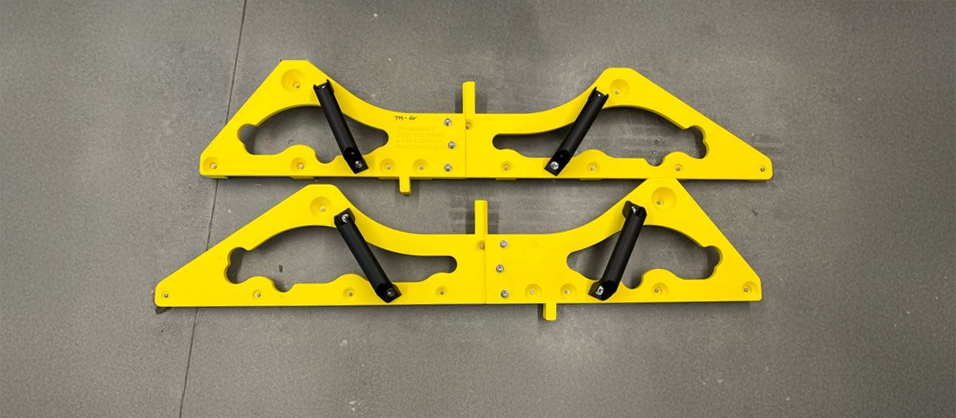
The positioning fixtures were printed with high-visibility yellow ASA material. The handles are standard off-the-shelf stock.
Iterate faster
The T25 High Speed Head allowed Subaru to streamline the manufacturing process on the Stratasys F770 platform, leading to better part quality, faster lead times and less dependence on third-party suppliers. Matt Daroff, Project Engineering Manager at Subaru of America, Inc., also points out that the team's internal customer now has more opportunities to identify areas for improvement that were not noticed during the development process. “We can make corrections earlier, minimizing time and material waste on defective output before production.”
Stratasys' 3D manufacturing solutions solve common problems with traditional tooling, such as long delivery times, high CNC costs and outsourcing risks. By making large tool parts in-house faster, manufacturers increase efficiency without sacrificing quality or control.
This article previously appeared at 3D Print magazine