






Sustainable use of plastics thanks to 3D printing
Plastics are indispensable in today's society, if only because of the weight savings that are possible with plastics. However, the sustainability image of plastics is under pressure. Can 3D printing change this?
It is clear how difficult it is to determine whether a certain production technology is more sustainable than another various studies that have since been implemented. AMGTA (Additive Manufacturing Grean Trade Association). In order to make a good judgment, the entire process must be examined in detail. However, 3D printing does offer potential for creating more sustainable products.

Less inventories
The first reason for this is that 3D printing is a fully digital production technique with virtually no setup costs. This makes the technology suitable for on-demand production like no other. This means that no inventories no longer need to be arrested. Last year, researchers from Nyenrode University concluded that this offers a significant advantage in the production of glasses. In the traditional workflow, there are stocks of every model in every color. Because classic production techniques often have setup costs and therefore a minimum order unit, there is always the risk that stocks will eventually have to be destroyed because the models are outdated by the new generation. This also applies to industrial products, such as components for mechanical engineering, which often keeps spare parts in stock for availability during service. 3D printing enables the on-demand production of these parts.
Less material
A second argument why additive manufacturing is a green technology is that material is only used where necessary in the product. While a CNC machine starts from a full block of material of which perhaps less than half remains, 3D printing does not use more material than necessary. This also applies to injection molding, but this requires a mold, there are setup costs and therefore there is a minimum order quantity to keep the injection molded product affordable. With 3D printing you can often save even more material by adjusting the design. Grid structures can provide strength and stiffness while requiring less material.
Stratasys PA11 powder based on vegetable oil provides better properties
Renewable raw materials
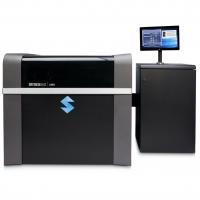
Stratasys, one of the co-founders of AMGTA, has sustainability high on its agenda. One of the ways in which the printer manufacturer makes 3D printing more sustainable is to use materials that are made as much as possible from renewable raw materials. A good example is the PA11 powder for the Stratasys SAF printers , the latest line of powder printers for industrial-scale 3D printing of high-quality plastic parts. Castor bean oil is used as the base material. These contain 40 to 60% oil and the remainder can be used by agriculture as fertilizer. The plant grows in tropical areas. In fact, it is also an inedible vegetable oil, so it does not compete with the food industry. Compared to PA12, based on fossil oil, PA11 provides higher ductility, higher impact force and higher fatigue resistance. Good material properties can therefore be combined with sustainable material production. Combined with the design possibilities of 3D printing and the minimization of inventories because single-piece production is economically possible, the Stratasys SAF H350 with PA11 offers a good start towards more sustainable plastic products.
Would you like to know more about how 3D printing can also make your products more sustainable? Ask one of our sales advisors.

Over 20 years of experience
Experience, expertise, and customer satisfaction are the cornerstones of our company.

Authorized distributor
Your AM partner in the Benelux, France, and the Nordics, with service operations and local offices in each region.

Go for the best deal
We offer a range of financing options to suit every use case, including renting, leasing, and trade-in solutions.